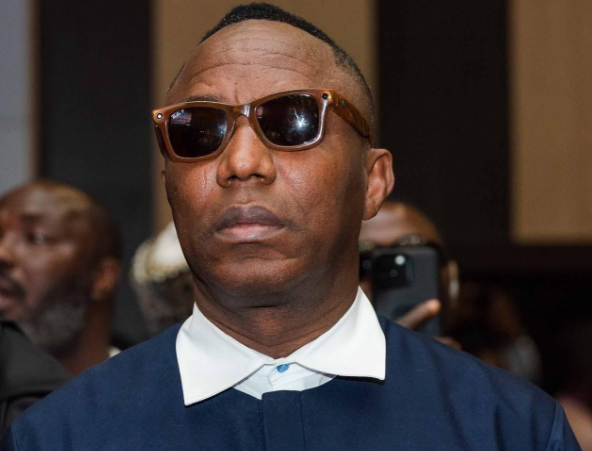
Human rights activist and presidential candidate of the African Action Congress in the 2023 elections, Omoyele Sowore, has defied a petition by the Department of State Services demanding that he retract a social media post in which he described President Bola Tinubu in a way that the DSS deemed “criminal and derogatory”.
The DSS, in a September 7, petition signed by Uwem Davies for the Director-General, said Sowore’s August 26 post on X (formerly Twitter) was “false, malicious, and capable of inciting public disturbance, disunity and breakdown of law and order.”
The letter, titled ‘Demand for Retraction of Criminal, False and Malicious Post Publication’, warned: “Your choice of words in the description of the President are false, malicious, and capable of causing insurrection. Those insidious statements have the effect of lowering the standing, estimation, and respect of Mr. President before the citizens of Nigeria and the comity of Nations.”
The agency demanded that Sowore “make an immediate and unequivocal retraction of the false and repugnant post,” publish apologies in at least two national newspapers and two television stations, and submit a representation to its Abuja headquarters within one week.
“If you fail to correct this false narrative, the Service shall, without further recourse to you, initiate measures it deems most appropriate within the ambit of the laws of the Federal Republic of Nigeria,” the petition stated.
But Sowore, in a response shared on X on Friday, rejected the DSS demands, describing them as “insidious, fundamentally defective, flawed in principle, and absolutely unlawful.”
“It is elementary that only the person defamed can sue. Therefore, your attempt to demand a retraction is an incompetent and unlawful attempt to hold the President’s brief,” he said.
Sowore, reflecting on his past ordeals, said that in 1993, while serving as Student Union President at the University of Lagos, he was seized by policemen during a peaceful pro-democracy protest and held for weeks at the notorious Inter-Centre near Ikoyi Cemetery after being taken through Awolowo Way in Ikoyi.
On his 2019 arrest, he added: “DSS agents invaded my hotel room, abducted me, and detained me for months over trumped-up allegations of treasonable felony, money laundering, and Cybercrime. Most disgracefully, your men invaded a Federal High Court presided by Justice Ijeoma Ojukwu to abduct me even after bail conditions were met.”
Citing legal precedents, he argued that criminal defamation was unconstitutional.
“Nigeria’s Court of Appeal in Arthur Nwankwo v. State (1985) struck down sedition laws. Justice Adekeye in IGP v. ANPP asked how long Nigerians must suffer under colonial-era public order ordinances designed to gag dissent.”
According to him, freedom of expression is non-negotiable in a democracy. He argued that criticism was indispensable in a democracy, stressing that freedom of speech covered the right to say what those in power found uncomfortable.
He also maintained that public officials must not be intolerant of criticism, adding that when boundaries were crossed, the proper remedy was civil libel, not unlawful repression.
“You have no business telling me how to criticise the President. The determination of the Nigerian people to reclaim their country from thieves in power is unwavering. Freedom cometh by struggle. Aluta continua, victoria ascerta,” he concluded.
Source: Punch Ng
Last modified: September 12, 2025